Sign up to our newsletter to keep up to date with news and information from CLP including events.

Wed, 21 Oct, 12pm - 8pm ACDT
Walkers Arms Hotel, Walkerville SA, Australia
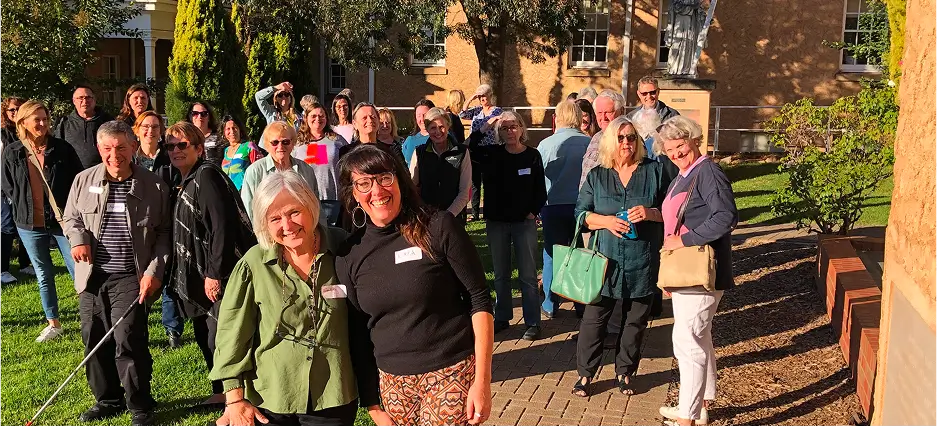
Learn moreCLP brings families together once every 2 years for a weekend of intensive learning and planning.
Each retreat has a theme and guest facilitator who brings their professional and personal experience. We also take the opportunity for families to share their stories and to connect and learn from each other.
Family members are encouraged to bring along another person in their unpaid support network and to partner with their Community Living or Circles of Support facilitators. This creates a small group of people who can focus and learn together, share ideas, and come away with next steps, and support to follow them through.
The retreat is funded and made possible by the JFM fund.
2026
Strategies for a good life, keeping things going
Margaret Rodgers, QLD
Watch Margaret Rodgers speak about the collective wisdom of a Circle of Support
2024
Seven steps to self-direction and safeguards for the future
Margaret Ward, QLD
Download the Seven Steps to Self-direction book from Resourcing Inclusive Communities
2022
Building today because the future is tomorrow
Janet Klees & Selena Blake, Canada
Watch Janet speak about her experience and insights.
2020 (event cancelled due to COVID)
Strengthening Family Leadership for Inclusion
Bruce Uditsky, Canada
2018
Managing my supports and lifestyle choices
Margaret Ward, QLD
2016
Transition and change to the NDIS
Bronia Holyoak, WA
Watch Bronia speak about the value of peer networks
2014
Exploring Possibilities
Heather Simmons, WA
Watch Heather’s TEDx talk “A world that works for everyone”
2011
Vision
Darcy Elks, USA
2009
Friendship
Deb Rouget, Vic
Find useful articles about building connections by Deb and others on the Belonging Matters website
2007
Hopes & Dreams
Jayne Barrett & Ross Womersley
2005
Home
Ross Womersley
Families usually have values and expectations that guide the decisions they make about raising and supporting their loved ones. They might not have ever called it a vision or written it down.
At CLP, we talk to the person and their families about the importance of holding a vision and the power of sharing the vision with others.
A person's vision for their life should include all life domains - the person's finances, health, wellbeing, spiritual fulfilment, work, community, home, and relationships.
This video about Hannah's community connections starts with the vision that Hannah's parents set for her from the very start.
CLP is guided by an approach that recognises the authority that a person's family members and key loved ones hold, and we encourage and support families to act on their power.
For starters, the family knows the person most deeply, with a lifetime of insight. Take for example the person's communication style and how best to support them with decision making. Anyone working in a paid role will learn about the person not only from them directly, but also from their family.
Families have a deeply personal stake in whether a service and experience is positive for the person.
For families embarking on making changes for their loved one, perhaps moving out of a group home or supported employment, it can take years of effort and coming up against barriers. We know that families can and do drive this change because they care are committed to holding the vision and setting the expectations for a good life.
Families bring their own fields of expertise, and contribute in a way that can complement and guide paid supports. Families are often best positioned to see how everything, in its entirety, adds up in a person’s life. They have insight into how different supports and services operate and interact with their loved one and can provide valuable input.
Dr Michael Kendrick has written widely on the natural authority of families. In this 6 Minute video recorded by Community Resource Unit, he discusses the topic.
"If we start with filling time, all we get is activities.
If we start with filling roles time takes care of itself!" Linda Shevellar
Watch the first few minutes of this video to hear Jack introduce himself and describe his valued roles and get a sense of how they shape a meaningful week for Jack. If you have time, watch the full presentation to hear how Jack’s family were guided by valued roles as they planned and supported their son into his first work role.
Neighbour is a role we all hold by default. We can elevate neighbour to a valued role. A good neighbour might -
A good neighbour makes a contribution to others. Then what might happen?
People get to know the good neighbour – know their name, know a bit about their routines and things they like to do. They might reach out to the neighbour when they have spare tickets to the footy, or to see if they need something picked up from the shops.
People value a good neighbour for their contribution. They might have previously made assumptions about the neighbour’s capacity, and now they know better. They might knock on the neighbour’s door and ask them to help with shifting furniture or other jobs needing extra hands. If they notice their neighbour hasn’t been out and about in their usual routine, they might check in and see if they are okay.
There are more roles we hold by default that can be expanded. Take for example family roles - what does a good cousin look like? Baking a birthday cake, collecting family history? Inviting to watch a favourite movie together? What could building on that valued role and connection lead to?
You might notice that when CLP advertise for support worker roles, there’s often a call for the applicant to have particular interests and skills – vintage cars, sewing, fishing, singing etc. This is because we recruit with valued roles in mind. We want to help the person to use their interests as a starting point to a valued role and connection.
For example – if someone likes drawing or painting, how could they move into the role of an artist? What do artists wear? What equipment do they use? Where can they meet up and connect with other artists?
We always strive for roles and settings that are typical for a person of that age and stage in life.
Once someone starts participating in a local club or group, we think about how they might start to take on valued roles that make a contribution and help the person to belong.
Watch the short video ‘no bias’ (6 minutes 30 seconds) and see the valued roles Michael has at his bowling club and how roles have led to connection.
Often people living with disabilities have been cast into negative roles – someone might be known as a burden, a client in every aspect of life, a child who will never grow up. As workers and allies, we bend over backwards to combat these perceptions. The best way we know to do this is to increase the person’s valued roles.
In this video Darcy Elks takes a deeper dive into the principles of valued social roles and how roles are pathways to full, meaningful, and inclusive lives. This video is 15 minutes long.
The principles of Valued Roles come from a theory called Social Role Valorisation (SRV), which was developed by Dr Wolf Wolfensberger. You can read more about SRV and valued roles at the Australian Social Roles Valorisation (ASRVA) website.
CLP delivers training workshops on Valued Roles and SRV. Check the Learning and Events page for upcoming dates.